
Barren County Tax Record Fields
Barren County property tax records come from several offices. The PVA tax information page covers Kentucky real property valuation at fair cash value, the January 1 assessment date, and the assessment roll. The Sheriff answers the current collection question. The Clerk's delinquent-tax file shows whether an unpaid bill has moved into certificate status.
| Field | What It Shows | Where |
|---|---|---|
| Assessed value | Value carried on the assessment roll | Barren County PVA |
| Appraised or fair cash value | Valuation field under Kentucky's full-value standard | Barren County PVA |
| Exemption indicator | Shows tax relief reflected in the parcel record | Barren County PVA |
| Current bill and payment | Amount billed and current collection status | Barren County Sheriff |
| Certificate of delinquency | Lien record created after the unpaid-bill process | Barren County Clerk |
Assessment and billing are separate jobs. The PVA values property but never sets the bill. Rates come from the taxing districts, so a value change and a bill change are not the same event. The office also separates appraised value, assessed value, sale price, and the sale ratio, which compares assessed value with sale price. A sale ratio is not a bill amount. House Bill 44 should not be read as a four-percent cap on one parcel's assessment.
Barren County Assessment Cycle
Every property in Barren County is reviewed on a four-year cycle, per the PVA, though any area may be reviewed at any time. An increase can therefore reflect several years of appreciation. Assessment ties to January 1, notices typically go out in April, and the inspection period begins in May. Those dates serve different parts of the process.
Match the tax year and parcel first. Then compare the PVA's land and improvement facts against the real property. If the site address, acreage, building facts, or owner display is wrong, ask the PVA about a correction. Errors on the assessment roll are correctable. The FAQ is clear on owner names. A name change requires an official recorded document, such as a deed or will, or a death certificate submitted to the office.
Barren County Tax Search Clues
The PVA offers a free basic property search. A subscription layer adds transfer history, photographs, improvement characteristics, class, and tax information. Both run through the hosted qPublic platform. Its live form controls can vary, so rely on the county's own descriptions of what the search returns.
| Search key | Best use | Confirm next |
|---|---|---|
| Street address | Find the likely parcel | Situs spelling and parcel identifier |
| Owner name | Find parcels tied to a name | Entity spelling and mailing address |
| Parcel number | Match assessment and bill files | Tax year and taxing district |
| Sale filters | Review qualified sale evidence | Date, price, acreage, neighborhood, sale type |
Keep the parcel number from the assessment result. It anchors everything. The parcel number is the strongest bridge to a tax bill, even when an address has changed or a rural site carries a mailing-city name that does not match its jurisdiction.
Look Up Barren County Tax
The Barren County Sheriff property-tax page handles current collection. That window generally runs from November through April. The Sheriff asks for the bill or bill information. The office also offers online and mail payment routes. Online ACH is listed at $1.50. Card or debit payment is described at approximately 2.75 percent. Check the live page before paying.
The official Sheriff tax source displays the payment details directly.
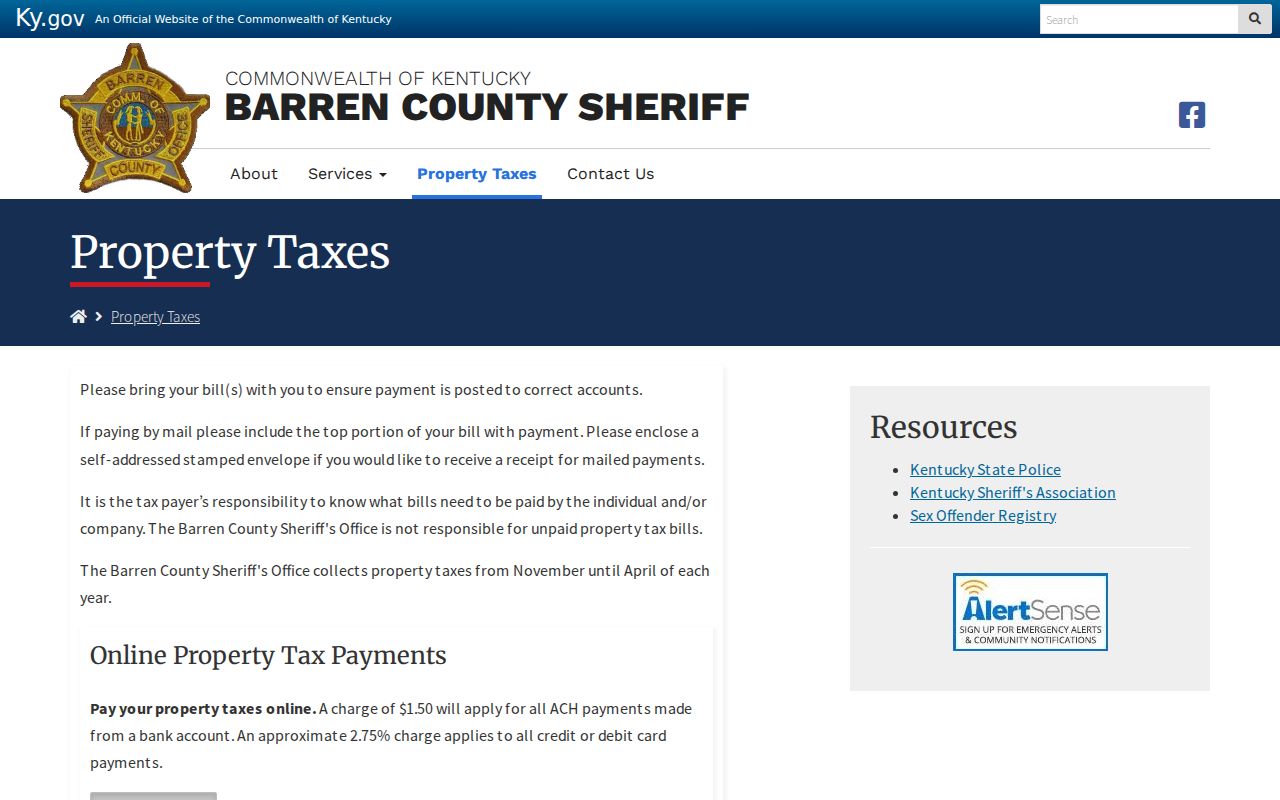
The Sheriff's page makes the split plain. Current collection sits with that office, so a PVA value search should never be mistaken for payment status.
- Find the parcel in the PVA record and note the owner, assessment year, value, and parcel number.
- Use the bill information with the Sheriff and verify the tax year, districts, total, and payment status.
- Return to the PVA record to confirm exemptions and whether the property facts are correct.
- For an older unpaid year, contact the Clerk to check certificate, purchase, release, and sale status.
- Assessed value
- The value placed on the tax roll by the PVA.
- Levy or rate
- The taxing-district rate applied in calculating a bill.
- Homestead exemption
- Statutory tax relief for a qualifying owner and property.
- Tax lien
- A legal claim tied to unpaid property tax.
Barren County Tax Delinquency
A bill still unpaid after April 15 of the year after it was due becomes a certificate of delinquency around April 16, per the County Clerk's delinquent-tax page. The certificate is a lien of record. That status is distinct from the PVA assessment and the Sheriff's current bill.
The Clerk says sales begin in September most years. Kentucky's Department of Revenue describes a broader statewide sale season and says lists are advertised before the sale. One dated Barren notice placed the 2025 sale on September 24, though that should not be treated as a current annual date. Call the Delinquent Tax Department at 270-651-3783 to ask whether a bill was purchased.
State guidance describes monthly interest plus Clerk and County Attorney fees. A third-party purchaser may add costs and pursue foreclosure. Sold bills lose the payment-plan route. A certificate is not a deed. Certificate, purchased bill, release, foreclosure, and deed are separate records, each held in the deed records and tax files where it belongs.
Barren County Tax Exemptions
The PVA forms page carries the exemption applications. Homestead and Disability use form 62A350. Nonprofit and religious groups use form 62A023. An exempt non-religious application is also listed, and the page links the Kentucky Property Tax Calendar, parcel map grid, mobile-home listing, map request, GIS license, and a request for reproduction of PVA public records.
An exemption is not a deed. It does not decide ownership. Confirm the qualifying rule, filing proof, and effective tax year with the PVA at 270-651-2026. If the question is what assessed and sale numbers mean rather than how the bill is collected, the Barren County property value explanation keeps those concepts separate.
Barren County Tax Evidence
Barren County tax evidence comes in five forms. Keep the PVA parcel card, the Sheriff's current bill or receipt, the Clerk's certificate of delinquency, any third-party purchase record, and later releases or foreclosure instruments separate. Each item answers its own question. Each can carry a different effective date. Dates and names do not always match. Before combining files, match the owner name against the parcel number and tax year on every item.
The PVA card answers the valuation question. Save it with the displayed tax year, land and improvement facts, exemptions, and the owner and address fields. The Sheriff's receipt answers something narrower: payment status for the one bill it names. It proves nothing about earlier years. When an old bill moved to the Clerk, ask about the certificate and whether it was bought, redeemed, assigned, released, or tied up in a court case.
Do not treat a tax sale as a finished transfer. The distinction matters. Kentucky's delinquent process can run through interest, fees, notices, a third-party purchase, and possible foreclosure before any later deed appears. Search the recording index for assignments, releases, lis pendens notices, judgments, and deeds tied to the parcel, and compare the court file when litigation is involved. That trail keeps a delinquent list from being misread as a list of already-transferred properties.
The Department of Revenue sets the economics. Delinquent bills accrue monthly interest plus Clerk and County Attorney fees, and sale lists are advertised before sale. Advertised notices come first. Check the live county list, because statewide timing and a prior year's Barren County sale date do not set the current schedule.
A written inquiry works best when it is specific. State the parcel identifier, the owner shown for the relevant year, the property address, the bill year, and the exact status you need. Ask the office to name the next custodian if the record has moved, since Kentucky's open-records rule requires an agency to identify the proper custodian for a misdirected request. Misdirected requests still get an answer.
Payment channels deserve equal care. The Clerk accepts mail payment by check or money order and in-person payment by check, cash, or card, with card fees added. Phone card payment is described on the delinquent page. The County Attorney handles payment plans, which never apply to sold bills. Confirm the payee and the current balance before sending any funds.
Dates decide what a document proves. A receipt proves only the payment named on it. A release shows that a recorded claim was cleared. Keep both in the file when you want a durable record of the parcel.
Appeal Barren County Assessments
Value disputes in Barren County start at the PVA office. The PVA appeal process begins with a required conference, held by phone or in person. Any owner may appeal, even without a notice. The inspection period opens on the first Monday in May. It runs 13 days, Saturdays included. An appointment is required. Bring proof if you have it. That proof could be an appraisal, photographs, insurance information, current listings, or sales evidence.
An unresolved conference can go to the Board of Assessment Appeals. Forms go to the County Clerk. They are due no later than one workday after the inspection period. The Clerk sends the hearing notice. A further appeal goes to the Kentucky Board of Tax Appeals. The PVA says no attorney is needed for the first conference.
Appeal window. First schedule the PVA conference during the 13-day inspection period, then meet the County Clerk filing limit for a Board appeal.
An assessment appeal contests value only. It never changes the deed, the recorded owner, a tax lien, zoning, or permit history, so keep those questions with their own custodians.